This topic is turning from a topic with useful techniques about video editing in a completely useless discussion topic… 
Why don’t you two just solve this via PM? 
This topic is turning from a topic with useful techniques about video editing in a completely useless discussion topic…
Why don’t you two just solve this via PM?
That others can follow how to find the right way.
lets-talk-about-video-editing-and-videos-in-general
and not
praise my videos how i do it.
Julio…should we delete our posts so that the others don’t feel disturbed?
I have no problem with it as we know what we found out already.
I think you misunderstood what I meant with layers of inaccuracy. It has nothing to do with filters or such.
Every time you encode a video with a codec such as h264 you will loose some image information. And these losses add up when you use an already lossy video as your source material for your edit and run it through a second round of encoding. You can only try to reduce that additional loss by using high bitrates in your second round of encoding. So your edited video file may be bigger than your source material.
I use high bitrates to preserve as much of what little image information my poor source material gives me. It’s not ideal, but that’s what you get when you have to work with poor source material. Maybe I could hardly tell the difference if I cut the size of my files in half, but who cares? The files we are dealing with, in the streaming age, are peanuts.
As the creator of this topic I will say this controversial debate is very much on topic. 
ya…i never had to encode multiple times. The last one should then be in the correct bitrate.
btw…i encoded the testscene also with 1000kbps and lower with no significant loss. A user who watches the video and want to find out where it has been better before would have to serach in original stream for differences and find the few frames with rosy’s face for example to compare and to complain about the loss of quality. And to even see the difference between 1000kbps and 3000kbps, he’d have to look very closely. That’s why I say it simply doesn’t make sense to choose such a high bitrate.
Might be a reason, that i developed many years database software and i also had to fight with people who said: it does not affect anything how much data you have. We have terrabites to store and big machines. But to think that is simply wrong.
A user (of our software) who gets his data on the screen for one client might not see the difference in performance (10 ms or 200 ms). But my routines had to deal with all clients at a job (calculate amount for a sub for example). And amount of data makes a difference in performance.
I can just say again…not everybody has highspeed internet and fast computer.
I work for them.
I don’t see why anybody should feel disturbed. Maybe one day somebody with real in-depth knowledge about video compression and encoding comes along and can point out our mis-conceptions. I would like that. I never claimed to be an expert, maybe some people make that assumption because I’m prone to writing lengthy essays here…
Can easy be found in internet. A link would be enough.
just ask google for example
‘does it make sense to convert a video, that has only 1500kpbs, with a higher bitrate?’
or
'what is the difference between limited MPEG and full range JPEG?
But if you not have a bit understanding of quality, details and bitrate, you will get also wrong impression.
For example simply ask
‘What bitrate for 4K?’ you will get 60.000kbps up to 100.000kbps.
But if you not have details from the capturing with that bitrate, it’s not the right answer. Because when already 20x20 pixels compressed into one, you will never get details out when you just upscale to that size. But that is what one need to know and understand.
Did you not read the other posts and the 100% ?
the people who ‘do not care’ about anything will never be and don’t want to be.
One last thing…the people who don’t want advice and just think ‘what a smart aleck’ may have misunderstood your topic. Or just me have misunderstood.
Nothing too special, I just recognized the movie they were watching, The Housemaid, and wondered if I could get the corner pin to match the camera movement.
That filter with keyframes really slows down the preview, so I decided to just compile it to see how it works. Took the damned thing over two hours to encode, so I didn’t bother to refine the edit any further. The corner pin filter has it’s own interpolation setting, and I set that to lanczos to, so there seem to be two instances of interpolation to be calculated.
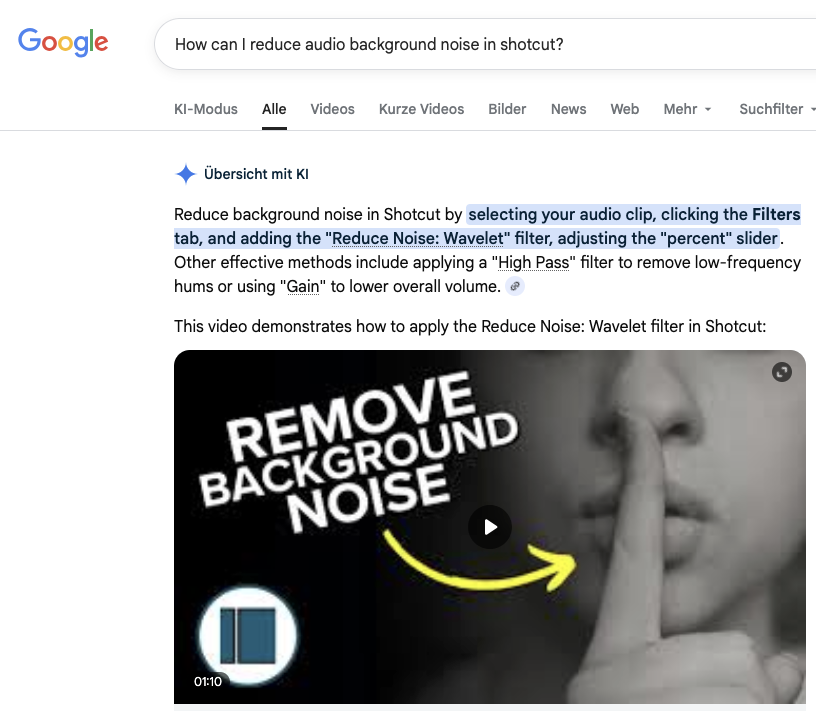
Google doesn’t know shit, it just regurgitates all the bullshit it reads on the internet. Note I specifically asked for AUDIO background noise and it recommends a video filter.
As always you have to look where it comes from. And not the upper short summary is what i mean. Maybe i should have said ‘search google’.
The wavelet algorithm seems to work for signals in general.
The algorithm in general may be usefull in audio noise reduction, too, but that filter in shotcut definitely is not. Yet you post another video spreading exactly that misinformation. You fell for the lie that google told you.
Video filters in shotcut have no effect on the audio. You can apply the Size, Position & Rotate filter to an audio track and shotcut will not bother to inform you that what you are doing is absolutely pointless.
The point is, I’ve experienced that, especially with Shotcut, google isn’t always that helpful. There’s just too many people out there writing stuff about it who have absolutely no clue what they are talking about. Including me, obviously. There are some good tutorial videos, many useless ones, and some are just plain wrong. I ran into this particular urban legend before, when I was actually trying to reduce some noise, that’s why I used it as an example.
I posted it to point out to try and see if it works.
Just a silly little joke. I had made one of my usual loop animations and ít looked almost as if Grossy was playing a musical instrument. So I measured her strokes and the beats of a classical Rock’n’Roll bass line and calculated a playback speed factor to try and sync it up. Not perfect but good enough for a visual pun.

Please know that this  is none of my doing, this burden was thrust upon me. Uneasy lies the head that wears a crown. Although, admittedly, I am no stranger to vanity. Anyway, who wants to come to my coronation party? There’ll be hookers and blow for everyone.

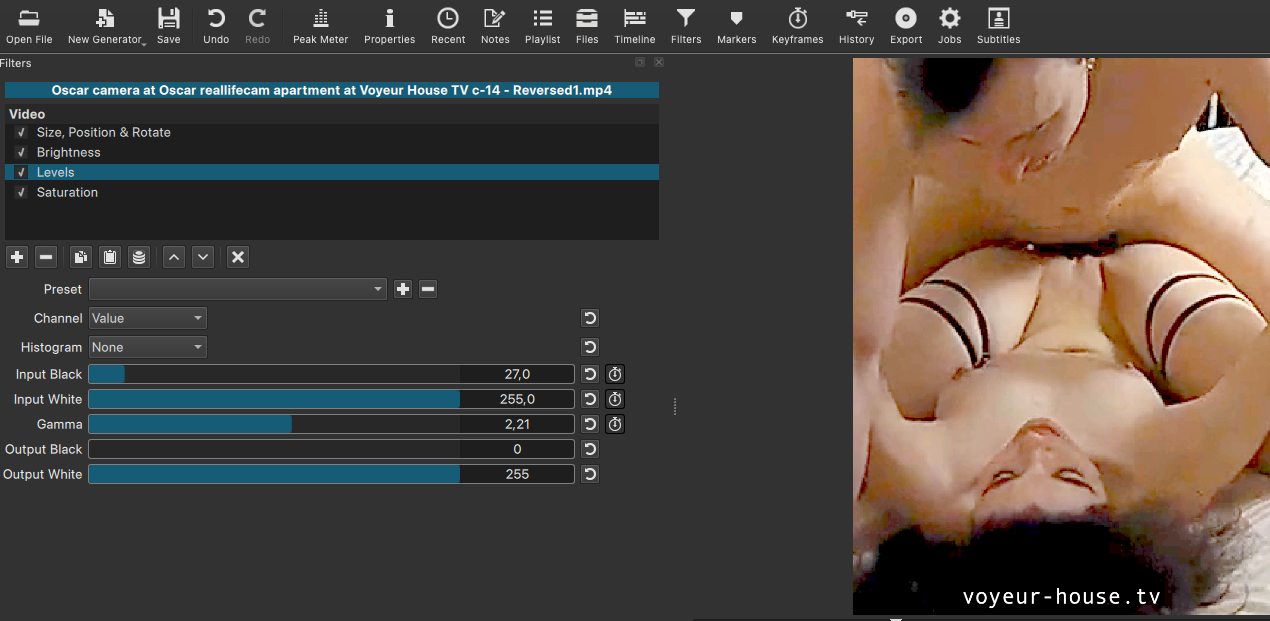
Just a quick reminder that with the lighting conditions on VHTV you sometimes may want to brighten up things a bit.

In Shotcut I use the filters Brightness, Levels and Saturation. In Levels, Gamma is the important one, though it does turn the darker colors into light grays. You compensate tthat by increasing Input Black

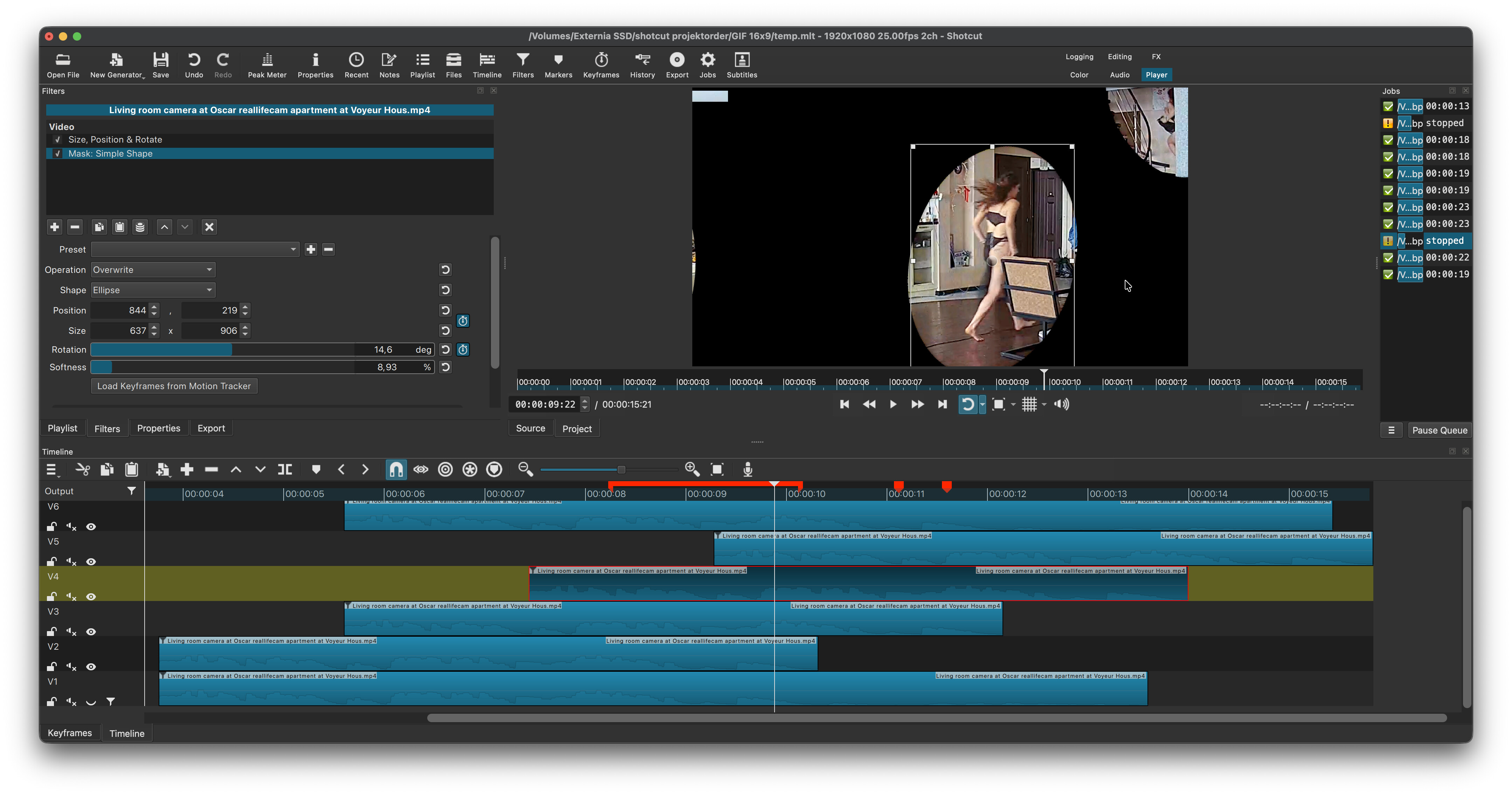
Video track V1 is the background plate which I have deactivated here for educational purposes.
On top of that is a clip in which I have isolated Jolanda in a simple mask filter with softened edges, trying to get the edges as close as possible to the edges of her head and feet, where later overlap may occur when the bubbles collide on the stairs.
Then I put a second copy of the clip on top and try out by what gap I have to stagger them so that it will still work. I can then add more instances of the clip staggered by the same gap. The shorter I can make the gap, the closer the Jolandas will be following each other, the more jolandas will be in the final clip and the cooler it will look.
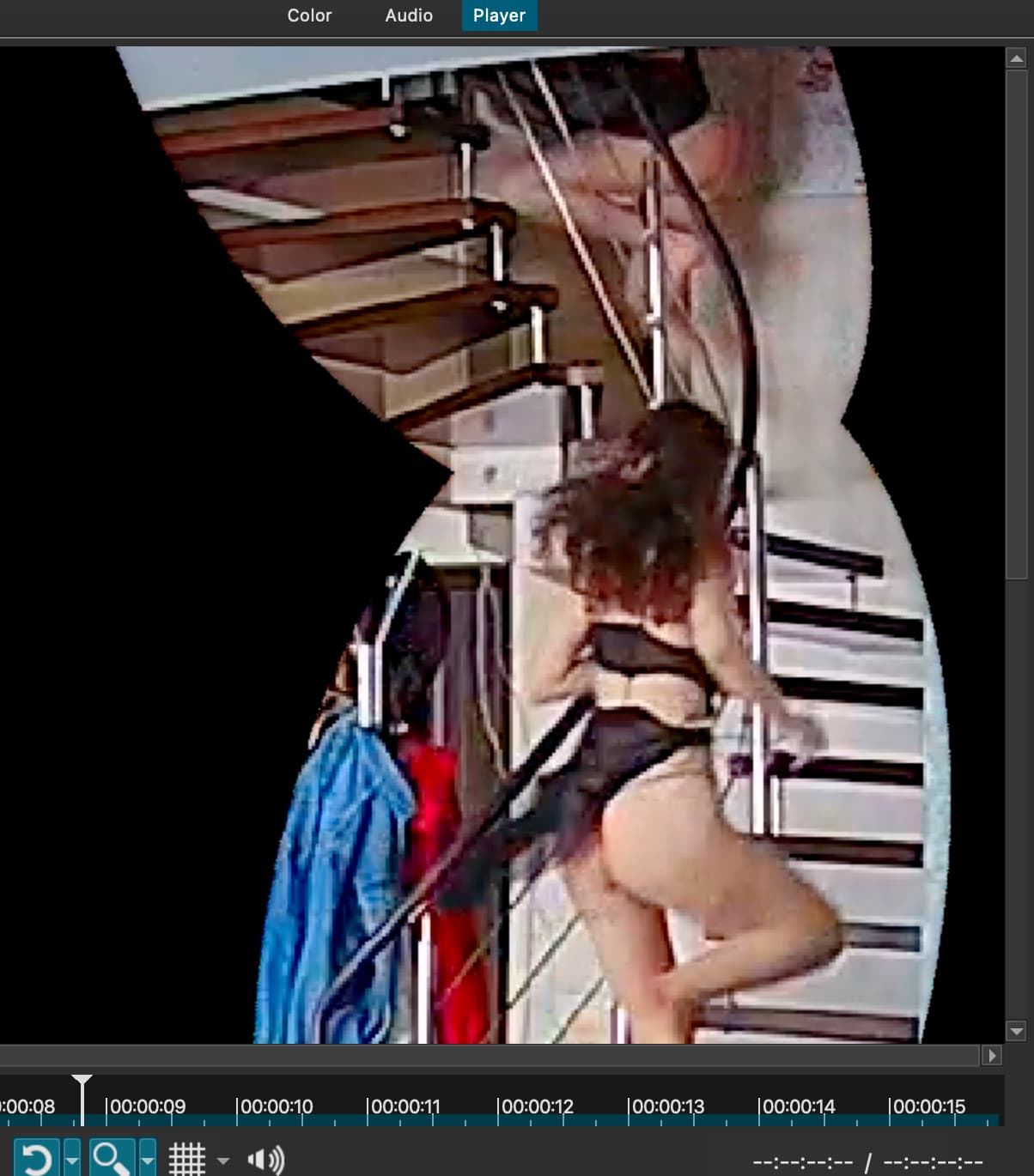
I’m actually pushing it a bit here, introducing an imperfection where her right foot disappears for a moment, but it’s pretty much imperceptible.
I could create a hand-drawn mask and put it really close around her outlines on a frame by frame basis, to make the gap shorter and squeeze more Jolandas in there, but that would be a lot of work.
The top video layer is just the little rectangle in the top left corner, to replace a part of the time stamp with a slightly shifted part of the ceiling.
Finally, the stretched red marker in the timeline marks the only part of the timeline that I’ll export as the finished webp loop. Note that the length of the marker is the length of the gap by which the Jolanda tracks are staggered.